Terentii Galuzin
Doctor ZhivagoTerentii Galuzin moves through the novel’s wartime disorder as a young man repeatedly treated as disposable: an expelled pupil, an awkward recruit, a fugitive believed dead, and finally an informant trying to save his mother. His survival depends less on political conviction than on improvised flight and family loyalty, yet the choice that expresses that loyalty also puts Strelnikov in danger.
Identity and Background
Terentii is the son of a man who makes speeches to young recruits and appears to possess a natural gift for public oratory despite having had no formal education. Terentii, by contrast, has been expelled from school. He tells Goshka Riabikh that he had been held back in nearly every other grade and that his expulsion has cost him the prospect of becoming an officer. His mother, he says, is deeply distressed by what has happened to him.
The family’s circumstances are set against a remembered past of greater security. Terentii’s mother recalls her own father as a sober, literate contractor, with a prosperous household and a life shaped by church services, dances, and local customs. Her account contrasts that earlier stability with the present, which she attributes not to revolution but to war and the loss of the country’s able-bodied men. The distance between her nostalgic recollection and Terentii’s uncertain prospects makes his expulsion part of a broader family experience of decline.
Flight and the Forest
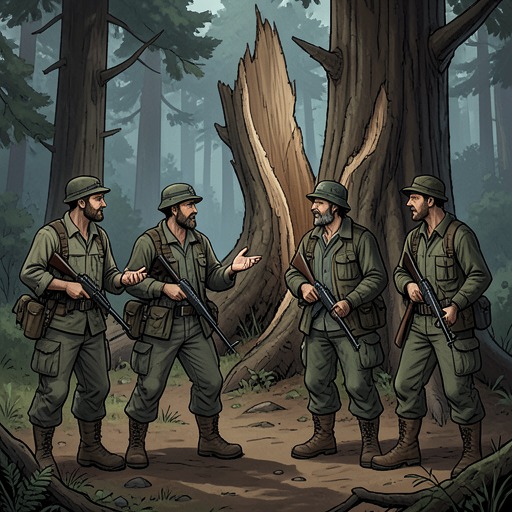
When local upheaval sends young men into hiding, Terentii takes refuge with Goshka and others in a cramped space beneath the floor of a village shop’s barn. He and Goshka whisper in panic while Koska Nekhvalenykh warns them that Strese’s men are searching nearby. Terentii explains that he followed Goshka’s cry to hide; he is not presented as a planner of the events around him, but as someone swept into danger by confusion and the actions of others.
The choice that follows turns this temporary hiding place into a route out of ordinary life. Terentii, Goshka, and Sanka Pafnutkin are told that the forest is the only place for them until the disturbance subsides, though they may later return. The provisional nature of this decision—flight for now, return perhaps later—anticipates a life in which shelter and safety are continually temporary.
Survival and Revelation
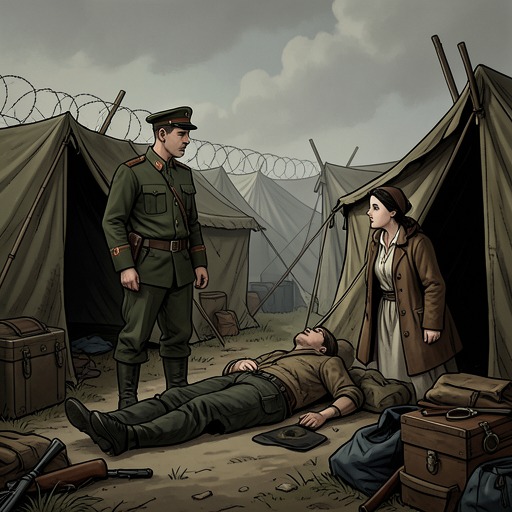
During Yurii Andreievich Zhivago’s journey through the abandoned railway corridor, Terentii appears unexpectedly among the shadows moving near the road. He darts from a snowdrift concealing a train of wagons and then disappears again. The sight corrects the belief that he had been shot dead: he had been wounded, lost consciousness, and, on recovering, crawled away from the execution site. He hid in the forest until he was able to travel, then made his way toward Krestovozdvizhensk under an assumed name, using the buried trains as hiding places and avoiding other people.
Terentii’s survival is later confirmed through Strelnikov’s account of his own flight across Siberia. Strelnikov describes meeting a tramp who claimed to have escaped a partisan firing squad after being wounded and left among the condemned. The boy’s account, including his flight from one hiding place to another and his expulsion from school, makes Zhivago recognize Terentii. When Zhivago asks whether the boy was Terentii Galuzin, Strelnikov confirms it; Zhivago adds that Terentii’s account of the partisans and the shooting was true.
Family Loyalty and Betrayal
Strelnikov identifies Terentii’s devotion to his mother as the one admirable quality he observed in him. His father has been shot as a hostage, and his mother is in prison, facing a similar danger. On learning this, Terentii decides to do what he can to secure her release. He goes to the local Cheka, gives himself up, and offers to work for them. The authorities agree to give him a chance on condition that he carry out an important betrayal.
Terentii tells them where Strelnikov is hiding. Strelnikov, however, escapes in time, so the disclosure does not lead to his immediate capture. The episode refuses a simple division between loyalty and treachery: Terentii’s action is a betrayal of the man whose hiding place he reveals, but it arises from an attempt to help his imprisoned mother. His decision also shows how family obligation becomes entangled with political power, which makes private devotion both a motive for action and a means by which the authorities can recruit him.
Narrative Role and Significance
Terentii’s story is assembled through separate glimpses rather than a continuous account of his life. He first appears in his mother’s anxious recollection of his expulsion, then in the hiding place with Goshka, and later as a supposedly dead boy glimpsed on the railway journey. Strelnikov’s recollection finally connects those fragments and clarifies what happened after the execution attempt. This delayed recognition makes Terentii’s survival a small but consequential reversal: the figure who seemed to belong to the dead returns as an actor in Strelnikov’s flight.
His path also links large political upheavals to vulnerable, local circumstances: a failed school career, a father’s speeches to recruits, a mother’s imprisonment, and a son’s bargain with the Cheka. Terentii is neither described as a committed partisan nor given a settled political identity. Instead, his movements—from home to hiding place, forest, railway line, and the Cheka—show how war and political conflict can force a young person into decisions whose consequences reach far beyond his immediate aim.